Learn by Doing: A Parent's Guide to Raising a Kid Who Builds
A practical, parent-facing guide to learning by doing at home: the method, the science that holds up, and how to raise a kid who builds, by age and budget.
The short answer
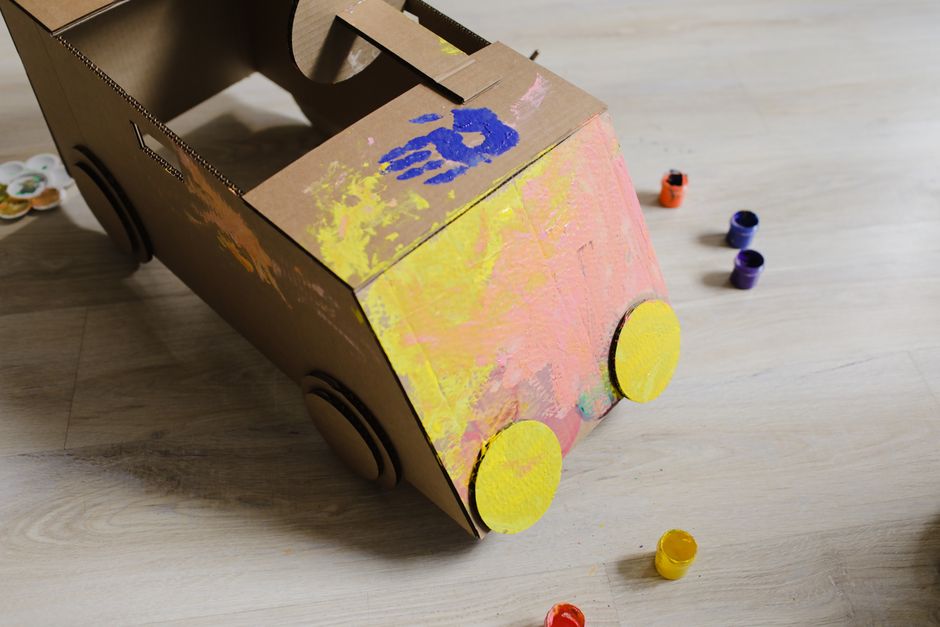
Learning by doing means your kid builds, tests and fixes real things instead of just being told about them, while you guide with questions rather than answers. The evidence is strong, and you need almost nothing to start: a real project, a few good questions, and the patience to let your kid get stuck.
Every parent has sat through the same scene. Your kid spends an hour on a worksheet about how plants grow, gets a tick, and forgets all of it by the weekend. Then they spend a Saturday afternoon trying to keep a sunflower alive in a yoghurt pot, kill it, work out why, and remember the lesson for years.
That gap is the whole idea behind learning by doing. Kids learn things they build, test and fix far more deeply than things they are simply told. It is not a new theory, and it is not complicated. The hard part is not understanding it; the hard part is resisting the urge to turn it back into a lesson.
This guide is the honest, practical version. What the method actually is, what the evidence really shows (and the popular myth to ignore), and how to do it at home without a classroom, a curriculum, or much money. The pieces underneath it go deeper on the specifics: turning screen time into build time, what your kid can build at each age, and how to set up a maker-space for almost nothing.
Start with a real kid and a pile of cardboard
In 2011, a nine-year-old called Caine Monroy spent his summer building an arcade out of cardboard boxes in the corner of his dad's used-auto-parts shop in East Los Angeles. Not a toy arcade. A working one, with games he designed himself: a basketball toss, a claw machine he rigged from cardboard and string, prize tickets that really dispensed. He worked out a price (a $2 "Fun Pass" got you 500 plays) and waited for customers.
Almost nobody came. The shop sat in an industrial part of the city with no foot traffic, and for most of the summer Caine had a grand total of one customer: a filmmaker named Nirvan Mullick, who had stopped in for a door handle and was floored by what this kid had built. That is the part worth sitting with. By any normal measure, the arcade had failed. The product worked and the market did not show up.
What happened next is documented in the short film Caine's Arcade: Mullick organised a flash-mob of strangers to turn up and play, filmed Caine's face when he walked out to a crowd, and put the video online. It was watched millions of times in days. It also started something bigger, the Imagination Foundation, whose first Global Cardboard Challenge ran in over 270 events across 41 countries, all built from cardboard and recycled junk.
Hold on to Caine for the rest of this guide, because his summer contains the entire method. He had an idea, built a real thing, hit a real wall, and kept going. He used no curriculum and almost no money. And the learning was not in a lesson about business or engineering; it was in the building, the breaking, and the figuring out. That is what we are trying to give our own kids, and it turns out there is good evidence it works.
What "learning by doing" actually means
Strip away the jargon and it comes down to a single shift: the doing is not the reward at the end of the learning, the doing is the learning.
Most schooling runs the other way around. First you are taught the concept, then, if there is time, you get to apply it. Learning by doing flips that. The kid starts with a real thing they want to make or solve, and the concepts get picked up along the way because they are needed to move forward. A kid building a marble run learns about ramps, gravity and momentum not because a lesson required it, but because the marble kept flying off the corner and they had to fix it.
The educational name for the structured version of this is project-based learning: the kid works on a real, open-ended project over time, hits genuine problems, and learns the underlying ideas in order to solve them. At home it does not need to be that formal. A project can be a treehouse, a working circuit, a small Roblox game, a bug hotel, a stall at the school fair, or a cardboard arcade. What makes it learning by doing is the loop, not the scale.
The science that holds up (and the myth to ignore)
It would be easy to oversell this, so here is the calibrated truth.
The evidence for project-based learning is genuinely strong. A 2019 meta-analysis by Chen and Yang, pooling 30 studies across more than 12,000 students in nine countries, found a medium-to-large positive effect on academic achievement, an effect size of about 0.71 compared with traditional instruction. That is a serious result in education research, where most interventions move the needle far less.
It is not just lab-flavoured findings, either. A randomized study run by Lucas Education Research put a project-based version of Advanced Placement courses up against the traditional version in several urban US districts. After one year, about 8 percentage points more students passed the AP exam (earned a credit-qualifying score of 3 or higher) in the project-based classes than in the traditional ones, a jump from roughly 37% to 45%. Same exam, same content, more kids clearing the bar, because they learned it by doing it.
Now the part most "hands-on learning" articles get wrong. You have probably seen the claim that "we remember 10% of what we read but 90% of what we do," often drawn as a tidy pyramid. Ignore it. Those precise percentages were never based on real research; they have been traced back and debunked repeatedly. The honest case for learning by doing does not need invented numbers. The real studies above are enough.
So the calibrated position is this: learning by doing is one of the better-supported things you can do, the effect is real and meaningful, and you should be suspicious of anyone selling it with a made-up retention statistic.
Your job: guide on the side, not teacher at the front
Here is the most useful idea for a parent, and the one that goes most against instinct. When your kid is building something and it goes wrong, the worst thing you can do is jump in and fix it. The best thing you can do is ask a question and wait.
The role is guide on the side, not sage on the stage. You are not there to deliver knowledge. You are there to keep the project moving and let your kid own it. In practice that means trading answers for questions:
- Instead of "the battery is the wrong way round," try "what have you checked so far?"
- Instead of "make the base wider so it stops falling," try "why do you think it keeps tipping over?"
- Instead of "that won't work," try "how will you know if it worked?"
This feels slower and slightly uncomfortable, because it is. Watching a kid struggle with something you could solve in ten seconds is genuinely hard. But the struggle is where the learning lives. When you supply the answer, you take the build, and the lesson, away from them. Nobody handed Caine a working claw machine; he failed his way to one. We go deeper on the emotional side of that, the meltdowns and the quitting, in Why Letting Your Kid Fail Is the Best Thing You Can Do.
A simple rule of thumb: help with safety and access (reach the high shelf, hold the wood steady), not with thinking. The thinking is theirs.
The build loop (the thing you are actually teaching)
Underneath every good project is the same repeating loop, and the loop is the real skill you are passing on:
idea → build it → it breaks → work out why → change one thing → build it again.
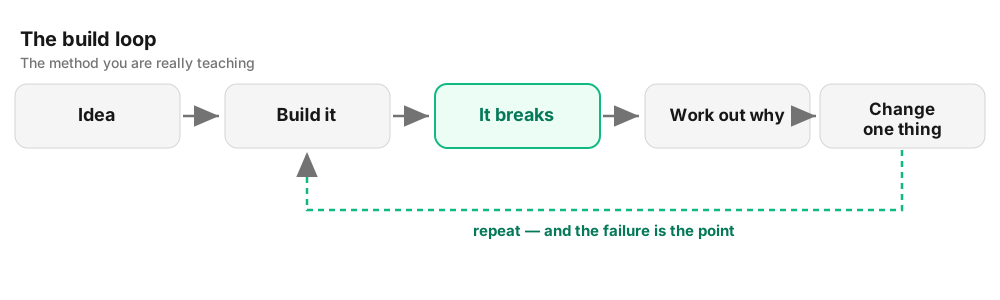
Notice that "it breaks" is not a failure of the process, it is a step in the process. The kid who internalises this loop has something far more durable than any single fact: a method for getting unstuck that works on a robot, an essay, a business, or a relationship twenty years from now.
Your job as guide is mostly to protect the loop. When the thing breaks, resist fixing it (that skips "work out why"). When they want to scrap everything and start over, nudge them to "change one thing" instead. The magic is in the iteration, and most kids will quit right before it pays off unless someone helps them stay in the loop one more time.
How do I pick a project my kid will actually finish?
This is where most good intentions die. A parent picks something impressive, the kid loses steam by day three, and the half-built thing becomes a quiet reproach on the shelf. The fix is to choose differently, and the choice is the kid's, with three quiet tests from you.
First, do they actually care about it? Interest beats impressiveness every time. A wobbly project your kid chose will out-last a brilliant one you assigned, because the motivation has to come from them, not from you. Caine did not set out to build a famous arcade; he started with one cardboard finger-soccer table because he thought it would be fun, and the more complex games grew from there.
Second, can a rough first version be finished today? The single biggest predictor of a kid sticking with something is shipping a first version fast, however ugly. "Make a worse version first" is real advice. A marble run that works badly tonight beats the perfect one that never gets built, because now there is something to improve, and a kid who finishes one rough thing is far more likely to start the next.
Third, can it visibly fail and be fixed? You want a project with an obvious success condition that breaks in fixable ways, so there is a loop to run. "Does the marble reach the bottom?" is a better project than "make something nice," because the first one tells the kid, plainly, when it is not working yet.
Pick for those three, and the project tends to survive contact with a real kid.
Doing this at home, by age
You do not need a project that looks like a school project. You need something your kid actually wants to make, scaled to what they can handle. Here is a rough sense of what "learning by doing" looks like at each stage, with a concrete starter for each. Treat it as a starting point, not a schedule, and let interest pull them forward.
| Age | A starter project (and the one thing you need) | Your role |
|---|---|---|
| 3–5 | A cardboard box "machine" (a car, a robot, a shop till) from a box and tape | Mostly get out of the way; ask "what happens if…?" |
| 6–9 | A marble run from a cardboard box and masking tape, challenge: get the marble round one corner without flying off | Set the goal, then trade answers for questions |
| 10–12 | A simple circuit that lights a bulb, or a micro:bit project that reacts to movement | Coach the loop; let real problems happen |
| 13+ | Something that ships to real people: a small stall, a game others play, a service | Step back; be a sounding board, not a manager |
Not sure where to start? Pick the row that matches your kid, choose whichever idea is closest to something they already like, and tonight just ask them to make a version that actually works. That single instruction, "make one that works," is the whole method in five words. For a fuller menu of builds at each stage, see What Can My Kid Actually Build? A By-Age Guide.
The screen-time angle (it is an ally, not an enemy)
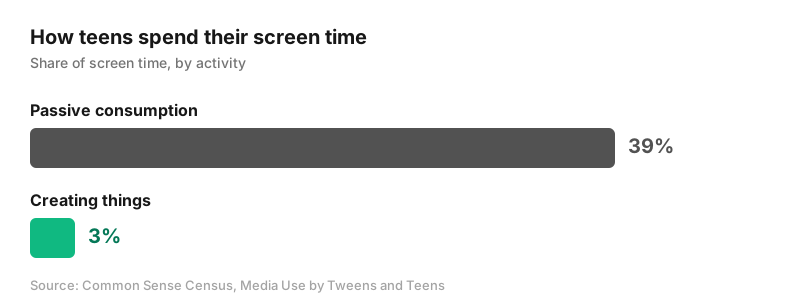
Most parents think of screens as the opposite of learning by doing. They do not have to be. The useful distinction is not screen versus no screen, it is creating versus consuming. According to the Common Sense Census, only about 3% of teens' screen time goes to creating things (coding, writing, making art or music) while 39% is passive consumption. That gap is the opportunity: a screen can be where a kid codes a game, designs a 3D-printed part, or edits a film.
For young children the picture is different. The American Academy of Pediatrics suggests up to about an hour a day of high-quality programming for ages 2 to 5, mainly because passive screen time at that age displaces the play and movement their brains need. But the principle scales: the question is always what the screen is for. The practical swaps are in Turn Screen Time Into Build Time.
You need almost nothing to start
If one belief stops parents, it is that this requires a kitted-out workshop. Caine built a viral arcade out of his dad's empty cardboard boxes. The most celebrated example of learning by doing in the last decade cost the price of tape.
So here is the genuinely no-cost first move, tonight: one cardboard box, scissors, tape, and a challenge your kid chooses. "Make something that holds your phone up." "Build a maze a marble can roll through." "Make a machine that does one useless thing." That is it. They will build it, it will flop, they will fix it, and you will have run the whole loop before bedtime.
When you do want to add a few things, do it cheaply and deliberately. Our guide to a home maker-space on any budget lays out a $0, $50 and $150 path, and, just as importantly, what not to buy yet.
Key takeaways
- Project-based learning has a medium-to-large effect on achievement (an effect size of about 0.71 across a 2019 meta-analysis of 30 studies), and a randomized study found about 8 percentage points more students passed an AP exam in the project-based version.
- The "we remember 90% of what we do" pyramid is a debunked myth with no research behind it. The real studies are enough; be wary of anyone who needs the fake stat.
- The method is a loop: idea, build, break, work out why, change one thing, repeat. "It breaks" is a step, not a failure.
- Your most useful role is guide on the side: help with safety and access, never with the thinking. The struggle is where the learning lives.
- It costs almost nothing to start. For ages 2 to 5, less screen is genuinely better; older kids can use a screen to create rather than consume (only about 3% of teen screen time is creation today).
To go deeper, see Turn Screen Time Into Build Time, What Can My Kid Actually Build? A By-Age Guide, and A Home Maker-Space on Any Budget. For the emotional side of letting a kid struggle, read Why Letting Your Kid Fail Is the Best Thing You Can Do.
Common questions
- What does 'learning by doing' actually mean?
- It means a kid learns a thing by making, testing and fixing something real, rather than by being told about it and tested later. Instead of a worksheet on circuits, they wire a light that turns on. Instead of a lecture on profit, they run a stall and count what is left. The doing is not a reward after the learning; the doing is how the learning happens.
- Does project-based learning really work, or is it a nice idea?
- It works. A 2019 meta-analysis of 30 studies covering over 12,000 students found a medium-to-large positive effect on academic achievement (d+ of about 0.71) compared with traditional teaching. A separate randomized study found that about 8 percentage points more students passed an AP exam in a project-based version of the course than in the traditional one, after one year. The effect is real, not just motivational.
- Do I need to be a teacher to do this at home?
- No, and trying to be one is usually the mistake. The most useful role is 'guide on the side': you set up a real project, then ask questions instead of giving answers. 'What do you think is going wrong? What could you try next? How will you know if it worked?' Your job is to keep them moving and let them own the build, not to deliver a lesson.
- How is this different from just letting my kid play?
- Free play is genuinely valuable and you should protect it. Learning by doing adds one light layer on top: a goal the kid cares about, and a loop of try, fail, change, try again. The difference between play and a project is usually just a question like 'can you make it actually work?' You are not replacing play, you are occasionally pointing it at something the kid wants to build.
Sources
- Chen & Yang, Revisiting the effects of project-based learning on students' academic achievement: A meta-analysis (Educational Research Review, 2019)
- Lucas Education Research, Project-Based Learning Boosts Student Achievement in AP Courses (2021)
- American Academy of Pediatrics, Media and Young Minds (Pediatrics, 2016)
- Common Sense Census: Media Use by Tweens and Teens
- The Global Cardboard Challenge (Imagination Foundation)
- Caine's Arcade (Wikipedia) — the cardboard arcade that started the Imagination Foundation
The weekly build prompt
One short email a week: a small, concrete thing your kid can build or try this weekend, plus the occasional story of a real family who built something. No spam, no lectures.
Keep reading
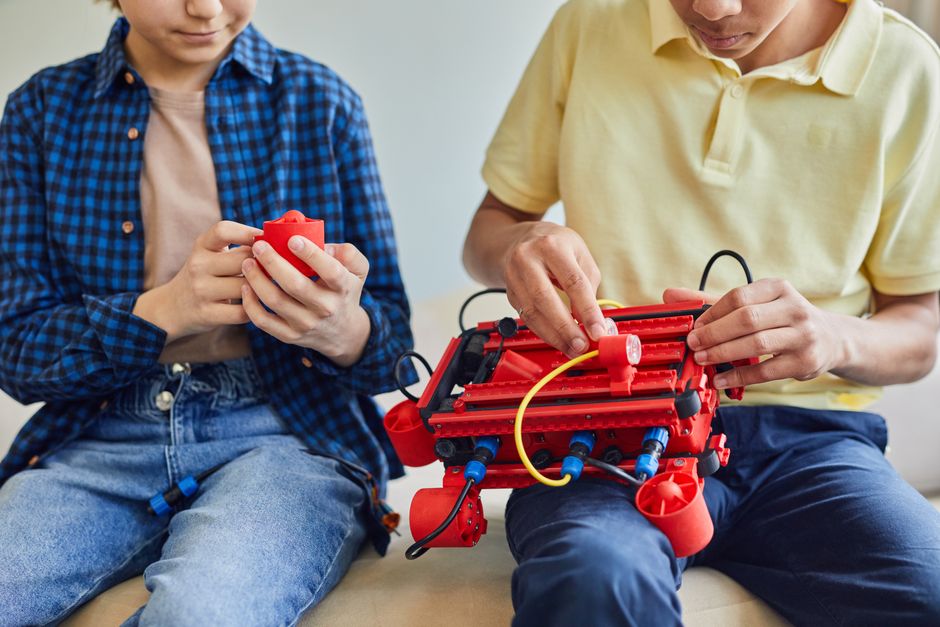
What Can My Kid Actually Build? A By-Age Guide
A realistic, by-age guide to what kids can build at home, from cardboard at 4 to a shipped project at 14, matched to what each stage can actually handle.
Read
Turn Screen Time Into Build Time (Without Starting a Screen War)
How to shift your kid from consuming screens to creating with them, without a fight. Swaps, the science of displacement, and what to try this week.
Read
A Home Maker-Space on Any Budget: What to Get, What's a Waste
How to set up a home maker-space for kids on a $0, $50 or $150 budget, what to buy, what genuinely waits, and the expensive mistakes worth avoiding.
Read
Why Letting Your Kid Fail Is the Best Thing You Can Do
An honest look at the growth-mindset research, then the part that works: the iterate-don't-quit loop to run with your kid when something breaks tonight.
Read
Coding, Robotics & AI for Kids: What's Worth It, and What's Hype
An honest, vendor-neutral guide to coding, robotics and AI for kids: what actually builds skills, what just sells kits, and what to do first by age.
Read